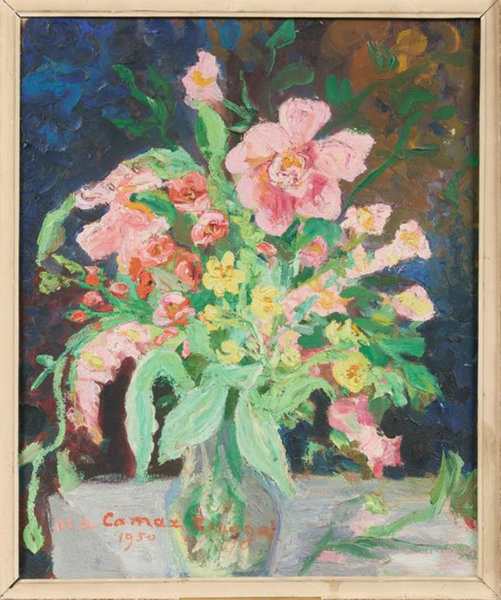
Marie-Anne Camax-Zoegger (1881–1952) was a prominent French painter known for her vibrant use of colour and her dedication to promoting women in the arts. Born in Paris, she was the daughter of Alsatian sculptor Antoine Zoegger, a collaborator of architect Viollet-le-Duc. After her father's death, she received encouragement from painter Jean-Jacques Henner to pursue her artistic talents. She studied under Ferdinand Humbert at the École des Beaux-Arts in Paris, one of the first institutions to admit women.
Artist: Camax-Zoegger, Marie Anne
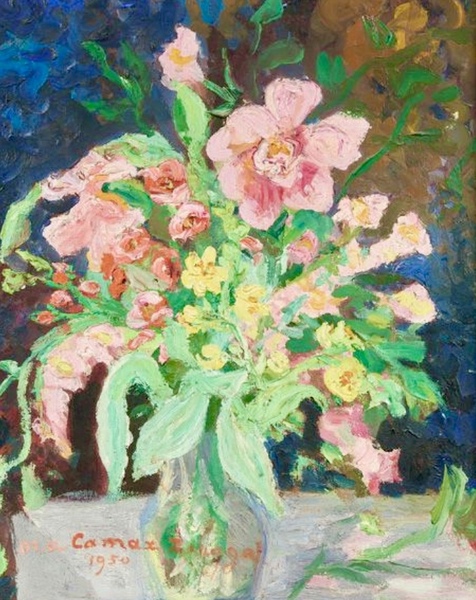
Camax-Zoegger began exhibiting at the Salon de la Société Nationale des Beaux-Arts in 1909. Following her marriage to Alfred Camax in 1910, she was able to focus entirely on her art. Her work gained recognition, leading to acquisitions by the French state for institutions such as the Musée du Luxembourg and the Petit Palais. She also received commissions for murals in public buildings, including schools and government offices.
Her artistic oeuvre includes portraits, still lifes, and landscapes. She often painted en plein air, capturing the natural beauty of places like Le Pouldu in Brittany and her family's estate in Etréchy. Her children, especially her daughters, frequently served as models, and themes of motherhood and childhood are prevalent in her work. One of her daughters, Geneviève, was portrayed by fellow artist Suzanne Valadon in 1936.
Beyond her painting, Camax-Zoegger was a staunch advocate for women artists. In 1929, she became president of the Syndicat des Femmes Artistes Peintres et Sculpteurs. In 1931, she founded the Société des Femmes Artistes Modernes (FAM), which organized annual exhibitions showcasing works by female artists, including notable figures like Suzanne Valadon, Marie Laurencin, and Tamara de Lempicka.
Her contributions to art and society were recognized through several honors: she was named Officier d'Académie in 1912, Officier de l'Instruction Publique in 1922, and Chevalier of the Légion d'Honneur in 1932. She was later promoted to Officier of the Légion d'Honneur in 1951.
Camax-Zoegger passed away in Paris in 1952. A retrospective of her work, alongside that of Suzanne Valadon and Louise Hervieu, was held at the Musée Galliera in 1961, reaffirming her significance in the French art scene of the early 20th century.